

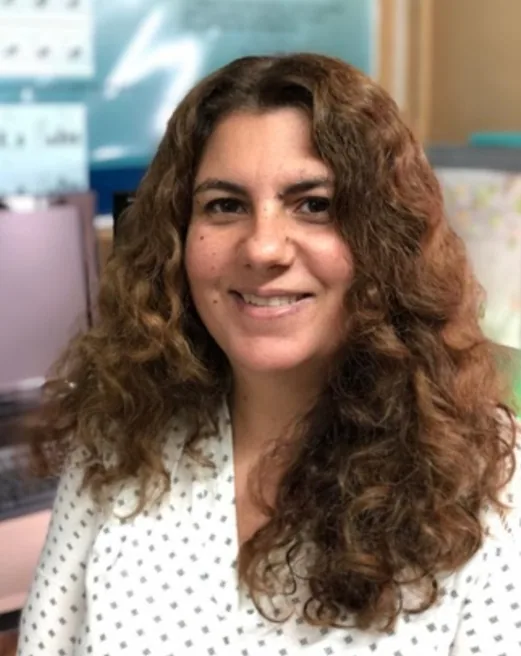
A team from Centro Basal Ciencia & Vida, of Fundación Ciencia & Vida - Universidad San Sebastián, led by researcher Daniela Sauma, observed that the presence of this molecule slows immune defenses, but also helps them remain active near the tumor. Adenosine is a molecule derived from adenosine triphosphate (ATP), the cell’s main energy source. In cancer, however, it plays a different role: it acts as a signal between cells in the tumor microenvironment.
A team from the Centro Basal Ciencia y Vida, of the Fundación Ciencia & Vida- Universidad San Sebastián, led by researcher Daniela Sauma, observed that the presence of this molecule slows down defenses, but also helps them remain active alongside the tumor.
Adenosine is a molecule derived from adenosine triphosphate (ATP), the cell's main energy source. In cancer, however, it plays a different role: it acts as a signal between cells in the tumor microenvironment, where damaged tissue, malignant cells, and the immune system coexist. When tumor cells die or tissue is under stress, ATP degrades and adenosine accumulates around the tumor.
Although this "chemical message" fatigues the cells that fight it, at the same time it helps them stay alive and remain at the combat site. With that evidence, researchers from the Centro Ciencia & Vida (FCV-USS), led by immunologist Daniela Sauma, warn that attacking adenosine directly, as has been suggested as a possible therapy, can be counterproductive.
Since the eighties, it has been known that adenosine acts as a brake on defenses: if added to T lymphocytes in the laboratory, their function decreases. Dr. Sauma's research focuses on CD8 T lymphocytes. Lymphocytes are white blood cells; CD8 T cells eliminate anomalous cells. In animal genetic models, the team observed that the activation of the receptor through which adenosine enters these lymphocytes promotes a state of functional exhaustion: they lose aim and strength to kill tumor cells.
In this line of work, the main model is melanoma. "Our results indicate that this adenosine receptor on T lymphocytes promotes exhaustion and, therefore, decreases their function," explains the researcher, who is also an academic at the Faculty of Sciences of the Universidad de Chile.
But she also observed that this same fatigue pathway also helps lymphocytes survive and remain inside the tumor. "Adenosine also promotes the survival of T lymphocytes; it keeps them there," she points out. When the adenosine receptor was removed from T cells in the model, the undesired effect appeared clearly: "If we remove the adenosine receptor, the lymphocytes disappear." By losing that receptor, they stop receiving signals that allow them to stay alive at the site. The brake is relieved, but at the cost of losing the immune system's own executors at the site where they are needed.
With that data, instead of blocking the reception of the message, Sauma's proposal is to intervene with CD73, the enzyme on the surface of lymphocytes that manufactures adenosine. "When we remove CD73 from T lymphocytes, we see that the lymphocytes are more functional, are in better condition, are in higher proportions, and survival is not affected," summarizes Dr. Sauma.
This also applies to CAR T cells, the patient's own cells reprogrammed to attack the tumor. If the receptor through which adenosine enters is removed from them, those CAR T cells lose effectiveness and stop killing tumor cells. The alternative is to preserve that receptor and deactivate CD73. With that adjustment, the CAR T cells remain in the tumor longer and function better. These are results in living models that guide the design of future therapies.
The group works with models with genetic modifications that, depending on the case, prevent lymphocytes from receiving the signal or eliminate components that generate it. With these tools, they evaluate function, permanence, and number of cells in the tumor. The data indicate that it is preferable to intervene with the enzyme that produces adenosine in lymphocytes rather than blocking the receptor through which the signal enters.
The research, which is being developed at the Universidad de Chile and the Centro Basal Ciencia & Vida, combines frontier science with human capital training, involving undergraduate and graduate students from various areas, who integrate into laboratory work, learn techniques and analysis, and then pursue careers at other institutions.
The team is also a reflection of the growing participation of women in biomedical research, with a culture of persevering and collaborative work. This is how she works closely with researchers María Rosa Bono, principal investigator of the Centro Ciencia & Vida (FCV-USS), and Sara Núñez. "We are like the Powerpuff Girls here," says Dr. Sauma with humor, before underlining that students and collaborators of different generations coexist in the laboratory, "without any gender exclusion."
By: Richard García. Agencia Sandoval y Meirovich.