

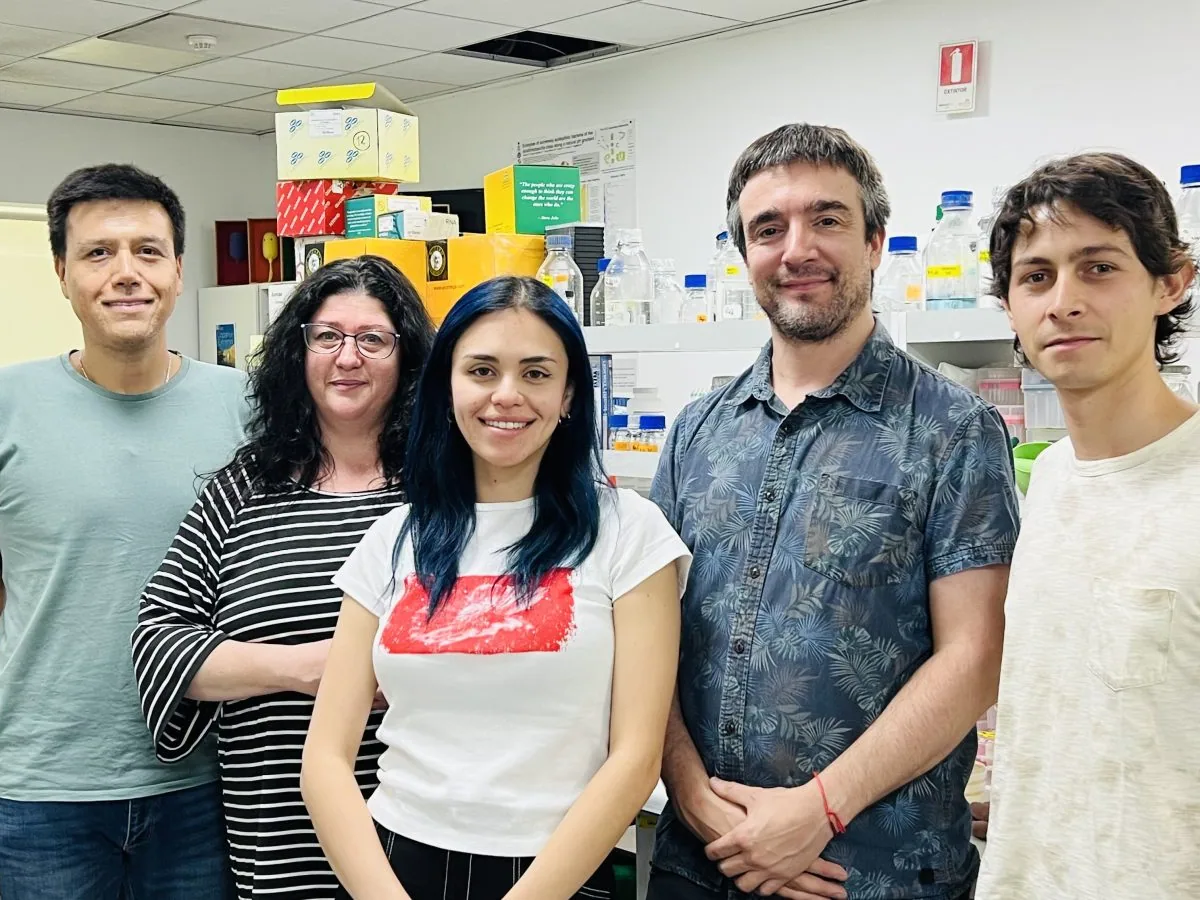
A team of scientists from Centro Ciencia & Vida, Fundación Ciencia & Vida and Universidad San Sebastián is developing an innovative “community engineering” platform to selectively neutralize the microorganisms responsible for one of mining’s major environmental liabilities: acid mine drainage.
A team of scientists from Centro Ciencia & Vida, Fundación Ciencia & Vida, and Universidad San Sebastián is developing an innovative “community engineering” platform to selectively neutralize the microorganisms responsible for one of mining's greatest environmental liabilities: acid mine drainage.
The research developed was funded through an Exploration Project from the National Agency for Research and Development (ANID), awarded in the first call for this innovative instrument.
The project, led by scientists Dr. Simón Beard and Dr. Raquel Quatrini, used gene-editing tools (CRISPR/Cas) encapsulated in lipid nanoparticles to create a high-precision system to eliminate bacteria responsible for acid generation in places where mining waste accumulates without affecting other native microorganisms present at the site.
An acidic legacy
Chile is the world's leading copper producer, with a production of 5.5 million tons of fine copper estimated in 2024. This activity has generated hundreds of environmental liabilities, such as the more than 800 tailings dams registered throughout the country.
When this mining waste is exposed to air and moisture, it can generate acid mine drainage. This phenomenon is characterized by affecting surface waters in contact with these materials, making them highly toxic, mainly due to two factors:
High acidity: The water progressively acidifies over time, potentially dropping to pH values as low as 0.5.
High concentration of heavy metals: along with the drop in pH, elements such as arsenic, lead, cadmium, and copper are solubilized, which are toxic to living beings.
The main cause of this environmental disaster is biological. A group of acidophilic and lithotrophic microorganisms, that is, those that like acidic environments and are capable of literally “eating” rocks, oxidize the minerals present in the tailings, generating sulfuric acid and releasing toxic metals into the environment.
As Dr. Simon Beard, a professor at Universidad San Sebastián and researcher at the Basal Center Ciencia & Vida, explains, "we seek to contribute from science with innovative solutions to face the environmental challenges of mining activity. From our experience in molecular microbiology of acidophilic bacteria, we wanted to explore the development of state-of-the-art molecular tools based on gene editing, in addition to adding the challenge of obtaining a formulation of vehicles for the delivery of these tools in acidic environments."
He adds that "a distinctive feature of our research is the incorporation of synthetic biology principles in the design of these molecular tools. We are very satisfied with the results, as we developed a platform of genetic parts and devices that we can combine and reuse to adapt the functionality and specificity of our tools very easily."
For her part, Dr. Raquel Quatrini, principal investigator and alternate director of the Basal Center Ciencia & Vida, and professor of the Biochemistry program at the Faculty of Science of Universidad San Sebastián, states: "the possibility of selectively intervening in microbial communities represents a central challenge in current biotechnology, with implications ranging from human health to sustainable mining. My research group seeks to understand the rules that govern the organization of microbial communities involved in bioleaching, and to develop tools that allow directing their functions, promoting beneficial processes or mitigating their negative impacts, such as acid mine drainage. Although still in the experimental validation stage, the results generated in this project bring us one step closer in that direction."
CRISPR and liposomes
The research team wondered if it was possible to use their knowledge about these microbial communities to selectively inhibit only the bacteria responsible for this problem without affecting the entire community. To do this, a strategy based on more than one layer of selectivity was tested, both in the delivery of the molecular scissors and in the cutting specificity of these in the genome of the target bacteria.
This proposal has its origin in two cutting-edge technologies:
CRISPR/Cas molecular scissors: The project uses the famous CRISPR/Cas gene-editing tool. This works like “molecular scissors,” composed of a protein that cuts DNA and an RNA guide that directs it to a specific site in the genome. The team's bet is to design guides that target DNA sequences exclusive to acid-generating bacteria, thus ensuring that the scissors destroy their genetic material without affecting the rest of the bacterial community, nor plants, fish, or animals.
A lipid nanoparticle vehicle (liposomes): For these scissors to work, they must survive the extreme environment of the drainage and enter the bacteria. To do this, the team explores the use of liposomes, which act as “soap bubbles” that encapsulate the CRISPR tools, protect them from acidity, and facilitate their fusion with the target bacteria, which can also be functionalized so that the delivery is targeted.
Catalina López, a Master's student in Molecular Biomedicine at Universidad San Sebastián, explains that "what we did was design molecular scissors based on CRISPR/Cas systems with precise instructions on where they have to cut in the DNA of the bacteria of interest. Another aspect of the development was to evaluate different promoters to regulate the amount of this molecular scissor, in order to obtain a genetic doser that allows us to increase or decrease the intensity of the system, avoiding unwanted or non-specific effects as a result of high levels of expression. Then we tested all the components in the laboratory to ensure that our tool only cut in the right place and under the desired conditions; we confirmed that the tool was specific, safe, and reliable before moving on to its encapsulation and delivery to demonstrate its operation in more complex systems."