

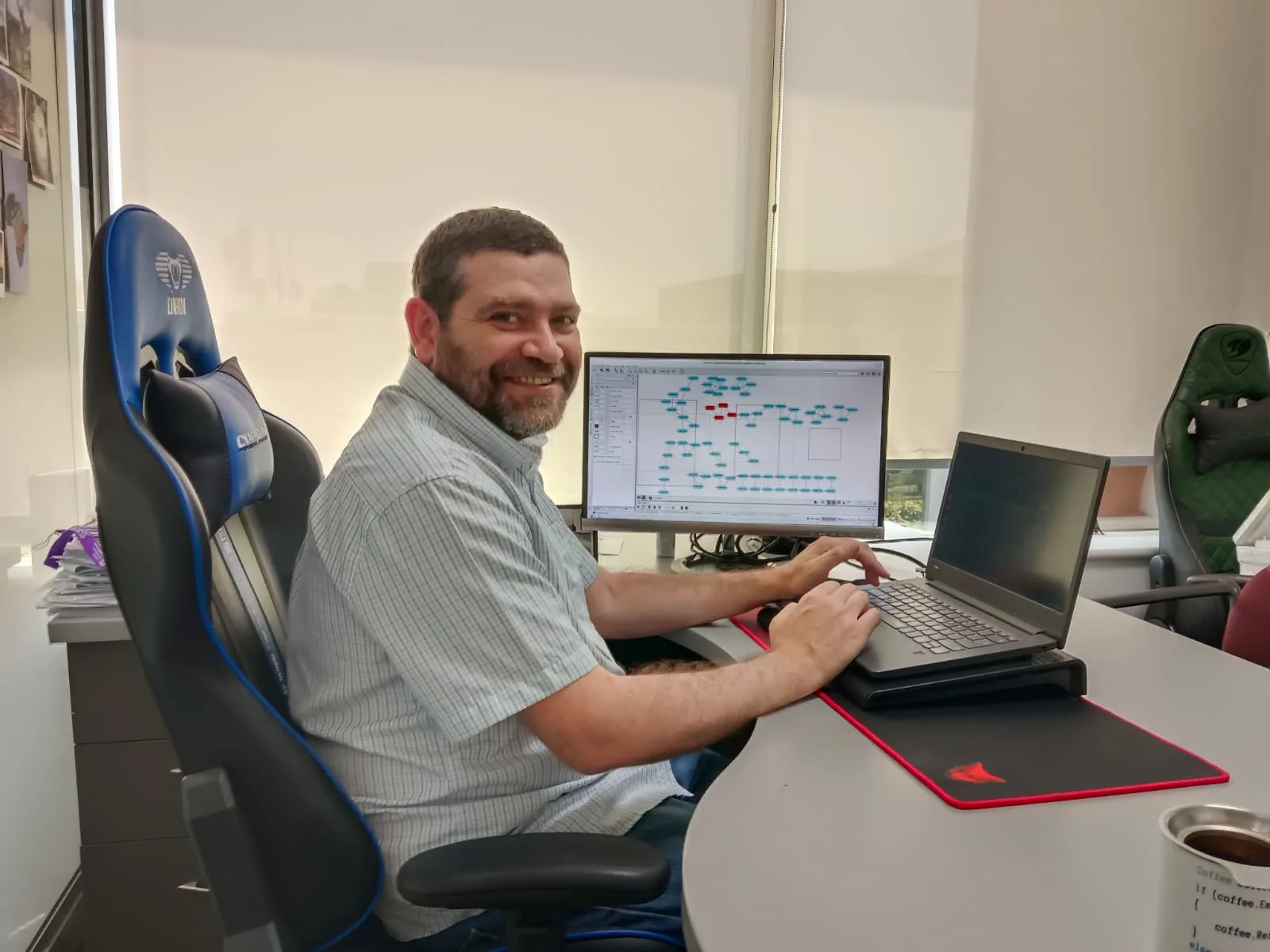
Dr. Alberto Martín is dedicated to collecting, processing, and refining this data to generate new knowledge, helping to achieve results that until a few years ago were far beyond the reach of human effort.
These high-performance devices allow transitioning from traditional “binary” analysis to discovering much more sophisticated findings, which are crucial for advancing basic science studies in areas such as tumor expansion or neurodegeneration.
Dr. Alberto Martín is dedicated to gathering, processing, and refining this data to generate new knowledge, contributing to achieving results that until years ago were far beyond the reach of human labor.
“The use of artificial intelligence algorithms helps us find relationships that are not so obvious,” notes the academic, who directs a PhD program in Computational Biology and recently secured a publication of global significance on the subject.
The use of supercomputers—or high-performance computers—in scientific studies is crucial for advancing the exploration of new associations that are difficult to obtain with traditional methods and that lead to more complex findings. All of this in the pursuit of providing the foundations of how living organisms function, understanding the mechanisms that fail in pathological contexts, and contributing, in the future, to the development of new treatments.
At the Centro Basal Ciencia & Vida, of the Universidad San Sebastián, Dr. Alberto Martín is the head of the Biological Networks Group, part of the Computational Biology laboratory, a unit that uses high-performance computational tools to support research in multiple fields, including various types of cancer and diverse aging-related diseases.
“What we do is take large volumes of data, process them, clean them, and transform them into new knowledge. The use of algorithms that learn on their own from the data helps us find relationships that are not so obvious,” notes this Spanish researcher, who has been based in Chile for over ten years and is the new director of the PhD in Computational Biology at the Fundacion Ciencia & Vida and the USS.
The team led by Dr. Martín—a biologist by training—collaborates with scientific groups within the Basal Center itself and also abroad. His field of expertise is data science from biological, biomedical, or experimental sources, mainly related to the control of gene expression and how living organisms regulate this fundamental mechanism. The most promising findings obtained are then validated in the laboratories of his collaborators.
The researcher explains that in databases for diseases such as Alzheimer's or certain types of cancer, there is a wide variety of information on gene expression levels in animal models, humans, and even plants. Traditional analysis interprets this data by determining which of all the genes are most related to healthy or diseased individuals. However, with the use of artificial intelligence algorithms, analytical capacity evolves exponentially.
“High-performance computing means using a group of dedicated computers in a coordinated manner to solve a task. The computing power we need to deal with the amounts of biological data available today is very high. The tools we use are optimized to squeeze the most out of both the data and performance, utilizing all the cores of each processor,” adds the academic, who holds a Master's in Bioinformatics and a PhD in Computer Science from University College Dublin, in Ireland.
According to the definition by the technology company Google, high-performance computing (also known by its acronym HPC) is the practice of aggregating processing resources to achieve greater performance than that of a single workstation, server, or computer.
HPC can take the form of custom supercomputers or groups of individual computers called clusters, as well as run locally, in the cloud, or as a hybrid of both. “It allows companies and researchers to aggregate processing resources to solve problems that are too large for standard computers to process individually or that would take too long to process,” specifies the North American giant.
Between Computing and Biology
High-performance computing helps make sense of the millions of data points available in various repositories of scientific interest on the Internet. Thanks to the use of mathematical models and artificial intelligence algorithms, scientists can find potential markers for their research by processing this information.
“Our main research focus is to understand how living organisms regulate the expression of their genes. A genome is like a library of manuals. The genes that compose it are each of those manuals. I liken it to a Lego toy manual. You take one and start building a car, you take another and build an airplane. Cells do the same with genes; the question is why this manual is read at one moment and not another,” points out Dr. Martín.
In addition to processing information, computational biologists work on representing data through networks. By organizing a system as a network, simulations allow the application of algorithms to automatically identify associations. It is a sort of coexistence between two worlds: data science and computer science on one hand, and molecular biology and biomedicine on the other.
In some cases, explains the USS academic, the same algorithms are used to predict market behavior or the weather for the coming days. “In this case, they help us determine that it is highly likely that a gene is not functioning properly or that it is related to a certain bacterium within a tumor, and that this could mean bad news for a patient.”
The data scientist comments that the algorithms performing these tasks are not characterized by great complexity. In fact, they are rather simple. However, when applied to complex problems, they allow for the validation of studies in experimental models or elucidate why some patients do not respond to treatments. “We always look for application cases to describe the utility of the methods we design and use.”
Once the algorithmic model demonstrates its reliability, the knowledge becomes available for use by any member of the scientific community thanks to a Creative Commons license (a free legal tool that allows users to use copyrighted works with a more flexible range of permissions for uses classified as “fair”).
“Today, we are working on several types of tumors and various neurodegenerative diseases. But we are also doing things to understand how plants regulate their gene expression, in order to understand which bacteria need to be put together in a reactor to create a certain metabolite, that is, a molecule of commercial or medical interest. Or understanding if those bacteria get along or if they harm each other by competing for the resources they need to proliferate.”
The incorporation of frontier tools such as artificial intelligence makes it possible to multiply the number of parameters of a sample like a blood test, going from 40 data points to more than 30 thousand per sample. “Loading that information into the memory of a supercomputer and starting to apply algorithms is what allows us to explore more complex associations. This type of AI algorithm only solves that particular task, or in some cases, you can force it to manage two or three. To put it another way, the algorithms we use in the Network Biology laboratory are never going to take over the world, because they only solve a specific task; that is, they are designed to determine a diagnosis and classify a patient rather than act intelligently,” notes Dr. Martín.
The Epigenetic Code
The journal Briefings in Bioinformatics—one of the most important in the field of Computational Biology worldwide—published the latest work developed by Dr. Alberto Martín's team and his biological networks group.
The article “Understanding the relationships between epigenetic marks and their application to the robust assignment of chromatin states” addresses the objective of understanding the control mechanisms of gene expression in the human genome. Normally, this control depends on the context in which it is found, but there is still a great lack of knowledge about the millions of data points that can derive from the behavior of the 35 thousand genes that make up the human DNA sequence.
“This occurs because there are proteins called transcription factors that bind to each gene and cause it to be read, expressed, or left ignored like a book on a library shelf. This regulatory mechanism, which is increasingly better understood, is not solely due to the regulatory protein being there, but to many other things happening in the cells. Among other things, and one of the most important, is the accumulation of other types of chemical signals associated with specific regions along the entire genetic material of the genome,” explains the biologist from the Centro Basal Ciencia y Vida of the USS.
Cellular DNA is wrapped around proteins called histones, which keep it organized. Different chemical modifications on different histones change the organization of the genome. In this “library,” genes are organized with tags, which would be these histone modifications that refer to their participation in different processes, just like books on a shelf. However, the combination of these categories, of different chemical modifications of histones, and what they imply for expressing one gene or another is one of the great mysteries for science, adds the specialist.
The exploration of tags, their linking to certain conditions, and experimental exploration demand enormous human, logistical, and even financial resources. Dr. Martín's work investigates 33 markers (which change the way genes are expressed) in four cell lines, in two different contexts. “We used our algorithms to understand the relationships of these marks. Before this, there were little more than correlations, and the associations between these marks were barely understood.”
“However, we began to see new associations between histone modifications, using vast computational resources over a long period of time, which provided us with new evidence of the existence of the epigenetic code. If these combinations we found between chemical modifications of histones are a code, it means there is a message to transmit; and that this message is first encoded and then decoded in order to carry out the instructions transmitted by the message.”
The specialist adds that, using their cascade of algorithms, they have discovered that it is possible to predict, based on the presence of some modifications, the existence of others, demonstrating their redundancy. “In other words, a few marks transmit the same information as many of them. We have also found evidence to say that the epigenetic code is degenerate, that there are several combinations of marks that allow determining the presence or absence of several other marks, which means that the same message can be encoded in different ways.”
The work—which was part of a doctoral thesis—will contribute to reducing, through the use of artificial intelligence algorithms and high-performance computers, the cost of experiments that demand high financial resources. “To reach these results, it is necessary to efficiently manage and organize large volumes of information and the coordinated use of many computational resources,” the specialist concluded.
Text by: Luis Francisco Sandoval. Agencia Inés Llambías Comunicaciones.