

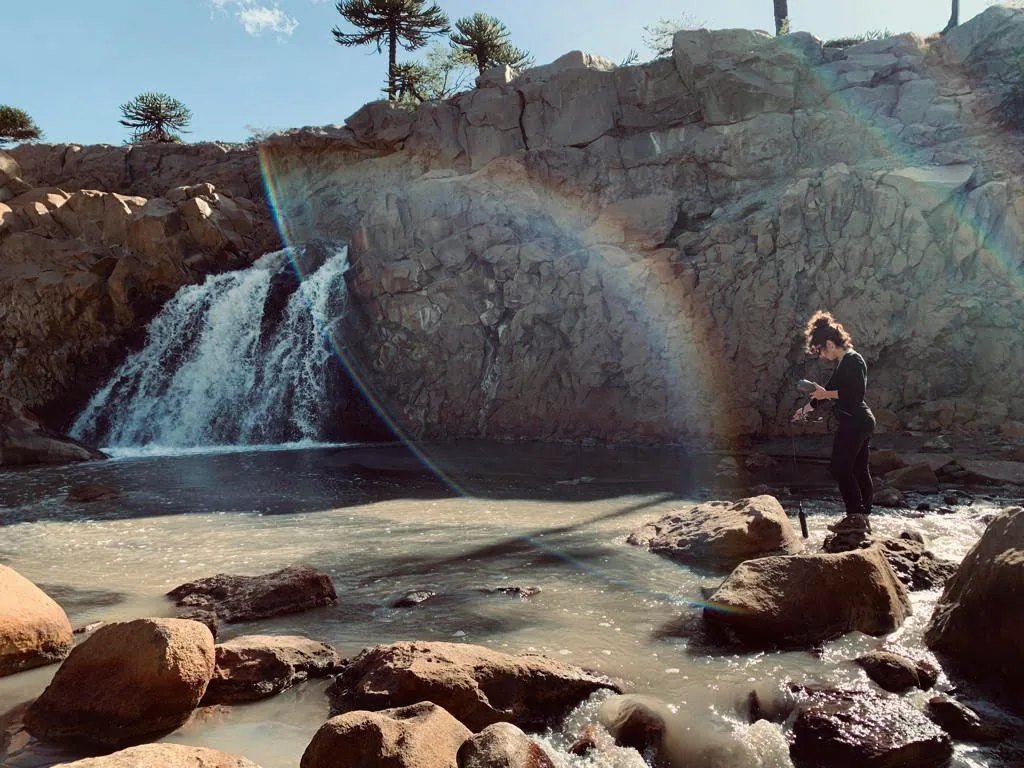
Biologist from the Centro Ciencia & Vida discovers evolutionary adaptation mechanism in bacteria from the Copahue Volcano
The finding demonstrated the ability of Igneacidithiobacillus copahuensis to survive in low pH conditions, high temperatures, and varying salt concentrations.
The work, recognized at an international meeting of the Society for Molecular Biology and Evolution, stood out for its contributions to microbial genomics as well as its potential applications in biotechnology and sustainable mining.
The researcher arrived in the country seven years ago from Turkey, interested in exploring acidophilic microorganisms and their ability to inhabit highly hostile environments, such as those found on the Chilean-Argentine border.
A study conducted at the Copahue–Caviahue volcanic complex, on the border between Chile and Argentina, showed how an acidophilic bacterium manages to genetically adapt to extreme environmental conditions, identifying the role of salinity as a key factor in its evolution.
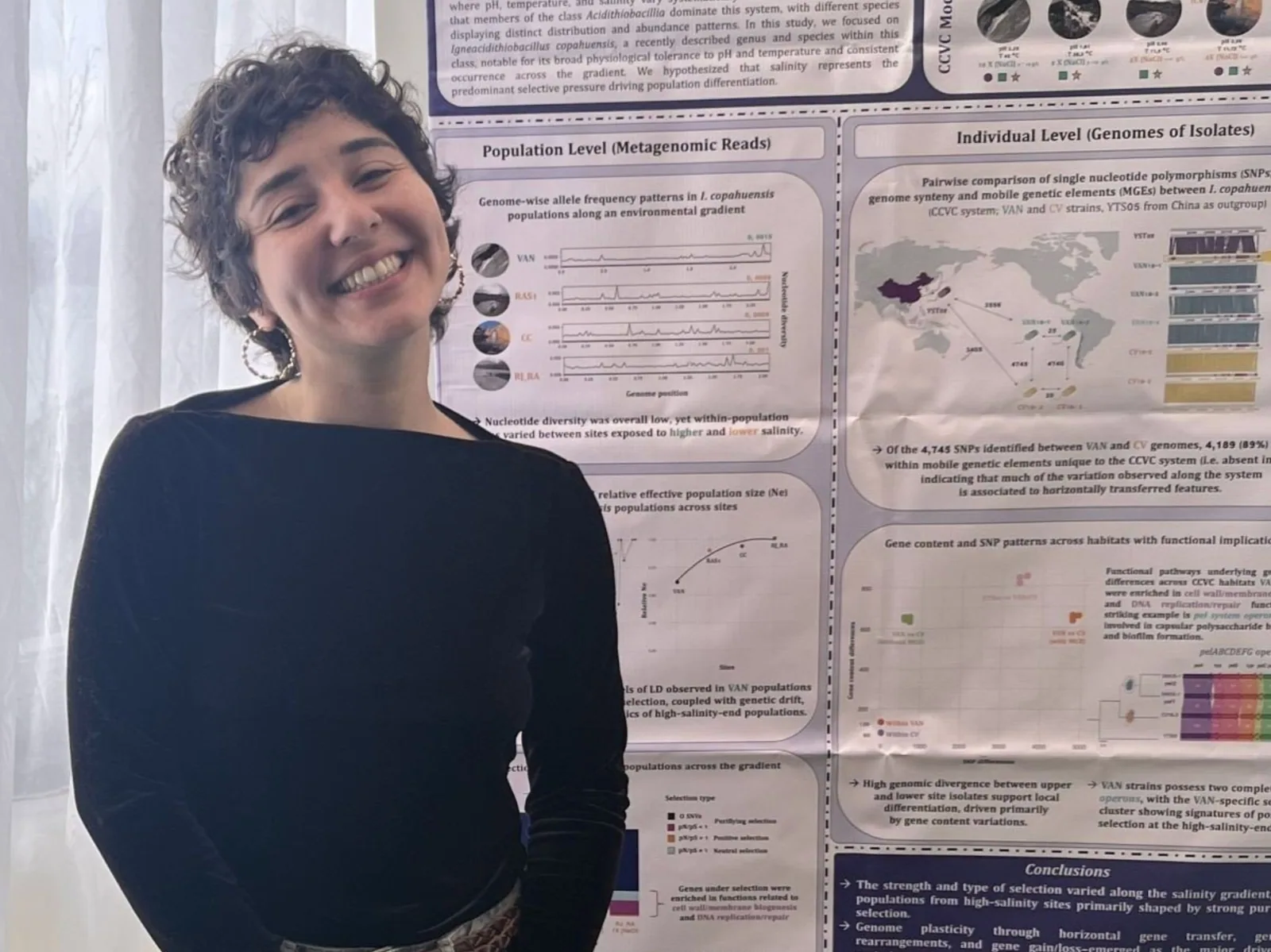
The finding, made by researchers from the Centro Ciencia & Vida (FCV-USS), as part of Dr. Dilanaz Arisan's doctoral thesis, was recognized as the best poster at the Society for Molecular Biology and Evolution (SMBE) conference held in Puerto Varas. The meeting brought together scientists specializing in molecular evolution and biological adaptation, combining studies in natural environments with experimental approaches.
The research focused on Igneacidithiobacillus copahuensis, a recently described bacterium capable of surviving in environments with extremely low pH, high temperatures, and varying salt concentrations. While other microorganisms also inhabit this system, this species is distributed throughout the entire salinity gradient of the volcanic complex, making it a natural model for studying how salt concentrations influence its adaptation and evolution at the genetic and phenotypic levels.
“We found an acidophilic bacterium that requires salt to grow, something very rare in this group, because normally these bacteria do not even tolerate it,” explained Arisan, a member of the Microbial Ecophysiology Laboratory of the Basal center. “Having presented the results of my doctoral thesis at an international conference with researchers from the United States, Europe, and Latin America, and having them value my work, was a very great honor.”
Acidophilic bacteria inhabit environments with pH values generally below 3, conditions lethal to most other life forms. They are found naturally in volcanic and geothermal systems, as well as in acid mine drainage and environments with high concentrations of heavy metals. They are also present in industrial contexts associated with biomining, where their ability to interact with minerals makes them an essential component of various processes.
Pioneering Exploration at Copahue Volcano
The Microbial Ecophysiology Laboratory , led by Dr. Raquel Quatrini, has as one of its central focuses the evolutionary, taxonomic, and genomic study of the class Acidithiobacillia, key microorganisms in both natural acidic environments and biotechnological applications. Furthermore, their work has been captured in the documentary Copahue Extremo, which contributed to making the science conducted in this environment visible in close collaboration with researchers from the Universidad del Comahue in Argentina.
“Dr. Arisan's research uses experimental evolution, a strategy still little applied in Chile, and demonstrates that these microorganisms resist a combination of conditions key to processing recalcitrant minerals such as chalcopyrite, a copper mineral highly relevant to current mining,” noted Dr. Quatrini, who emphasized that the study addresses a highly relevant scientific question: how microorganisms are able to adapt, simultaneously, to extremely acidic pH and high salinity conditions, a combination almost non-existent in nature and of enormous physiological demand.
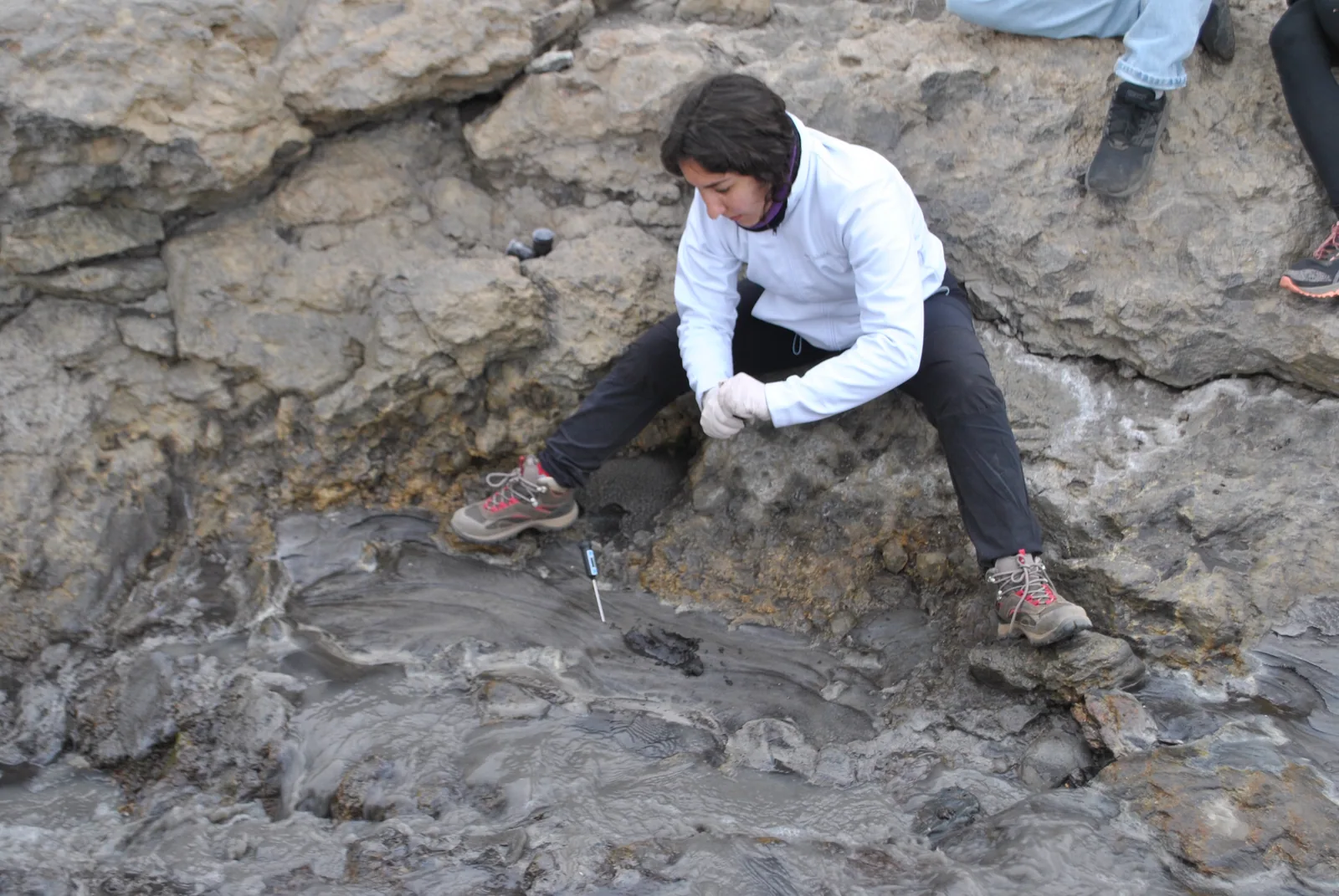
The scientist added that the work—which is part of the thesis for the PhD in Biotechnology and Bioentrepreneurship at the Universidad San Sebastian—is situated at the frontier between ecology and evolution, exploring the genetic and molecular bases of this adaptation. Her fieldwork involved collecting samples in hard-to-access sectors near the active crater, with the aim of characterizing microbial communities capable of surviving in conditions at the limits of life.
This approach integrated direct ecological observations with subsequent genomic analyses, strengthening the link between nature and experimentation.
“The recognition obtained by Dilanaz at an international conference is very fair and well-deserved: even presenting a poster, she managed to convey the weight of her thesis and validate her work before experts in the field. Her thesis is interesting from a fundamental perspective because it studies organisms that tolerate a very rare combination of extremes: low pH and high salinity, addressing adaptation from ecology and evolution,” said Dr. Quatrini.
The Evolutionary Force
The study identified that salinity acts as the main selective force for the genetic differentiation of acidophilic bacteria populations (specifically, populations of Igneacidithiobacillus copahuensis) in this extreme geothermal system. The Copahue–Caviahue complex presents highly variable conditions of temperature, acidity, and water chemistry, which allowed for the analysis of how these variations influence microbial evolution within the same natural system.
The results showed that the populations of I. copahuensis inhabiting more saline areas show signs of purifying selection, an evolutionary force that eliminates harmful genetic changes and preserves functional traits. These bacteria exhibit lower genetic diversity and smaller population sizes, suggesting more intense environmental pressure than in other sectors of the volcano. They are also the most salt-tolerant populations.
The greatest differences were found in mobile genetic elements, DNA fragments capable of being transferred between bacteria. In particular, genes associated with the formation of capsules and biofilms were identified, structures that protect bacteria against adverse conditions such as high salt concentration. Overall, the work shows how evolution can be observed in action in an extreme natural environment, where environmental selection, genetic exchange, and local specialization allow these microorganisms to thrive in conditions where few life forms could.
“Today we can sequence everything present in an environment, that is, all the DNA of the bacteria living there, without the need to culture them one by one in the laboratory. And furthermore, work at the population level, not just individuals, observing their changes over time,” said the Turkish scientist.
An Extreme Environmental Gradient
Environments such as thermal volcanic systems offer conditions that significantly increase the survival challenge for life.
In Copahue, this scenario is expressed in a marked environmental gradient: in the upper part of the system is the Crater Lake with a pH near zero, high temperatures, and high concentrations of dissolved metals. In contrast, as the water flows from the springs near the crater toward lower areas, it mixes and dilutes with meltwater from other tributaries, giving rise to a river where pH, temperature, and salinity change progressively.
“We work with the volcano as a model system. By collecting samples at different points of the gradient, we seek to understand how these environmental conditions affect microorganisms,” Arisan explained.
The researcher emphasizes that understanding these mechanisms not only contributes to fundamental knowledge in evolutionary biology but also has practical implications. Extremophilic microorganisms are used in biomining, where they facilitate the extraction of metals of economic interest with lower energy and fresh water consumption than traditional methods.
The genetic analysis of these bacteria was possible thanks to the use of modern genomic and metagenomic sequencing tools, which allow for the study of complete microbial communities directly from environmental samples. These techniques make it possible to compare populations, identify genetic variants, and observe how they change over time under different environmental pressures.
Global Visibility of Studies in Chile
The recognition obtained at the SMBE conference reinforces the international projection of the work developed at the Centro Ciencia & Vida (FCV-USS) and the contribution of research conducted in Chile to fundamental questions about microbial evolution. This was the main reason that led Arisan to arrive in the country seven years ago from Istanbul, Turkey, to join Dr. Quatrini's laboratory.
After an initial internship, she continued her doctoral studies, which she completed in 2025. Her trajectory reflects the international nature of science and the importance of knowledge flows between countries. Her work not only contributes to scientific advancement but also serves as inspiration for students and young researchers interested in exploring life in the most inhospitable environments on the planet.
“Studying how microorganisms adapt to extreme environments is not only relevant to understanding evolution in a specific volcano. These systems function as natural laboratories that allow us to anticipate how life responds to drastic environmental changes, key knowledge on a global scale in a context of climate change and increasing pressure on ecosystems,” Dr. Arisan concluded.
The Copahue volcano is an imposing stratovolcano nearly 3,000 meters high on the border between Chile and Argentina, with a broad base covering about 160 km². It has had moderate eruptions in the past, such as in 1992, 2000, and 2012, which could generate mudflows in nearby rivers, but always under constant surveillance, according to the National Geology and Mining Service.
Text by Luis Francisco Sandoval, S&M Comunicaciones Agency.