

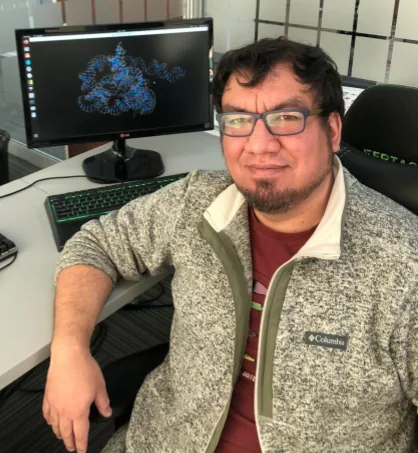
Biophysicist Simón Poblete, a specialist in multiscale modeling of biomolecular biological systems, explains that the internal organization of genetic material could determine its application as vehicles for genetic information.
Research between Centro Ciencia & Vida, of the Fundacion Ciencia & Vida – Universidad San Sebastian (FCV-USS), and the Institut Pasteur de Montevideo aims to understand how DNA packaging within this virus influences its stability, a line of research with enormous therapeutic potential, they highlight.
Biophysicist Simón Poblete, a specialist in multiscale modeling of biomolecular biological systems, explains that the way genetic material is organized internally could determine its application as vehicles for genetic information.
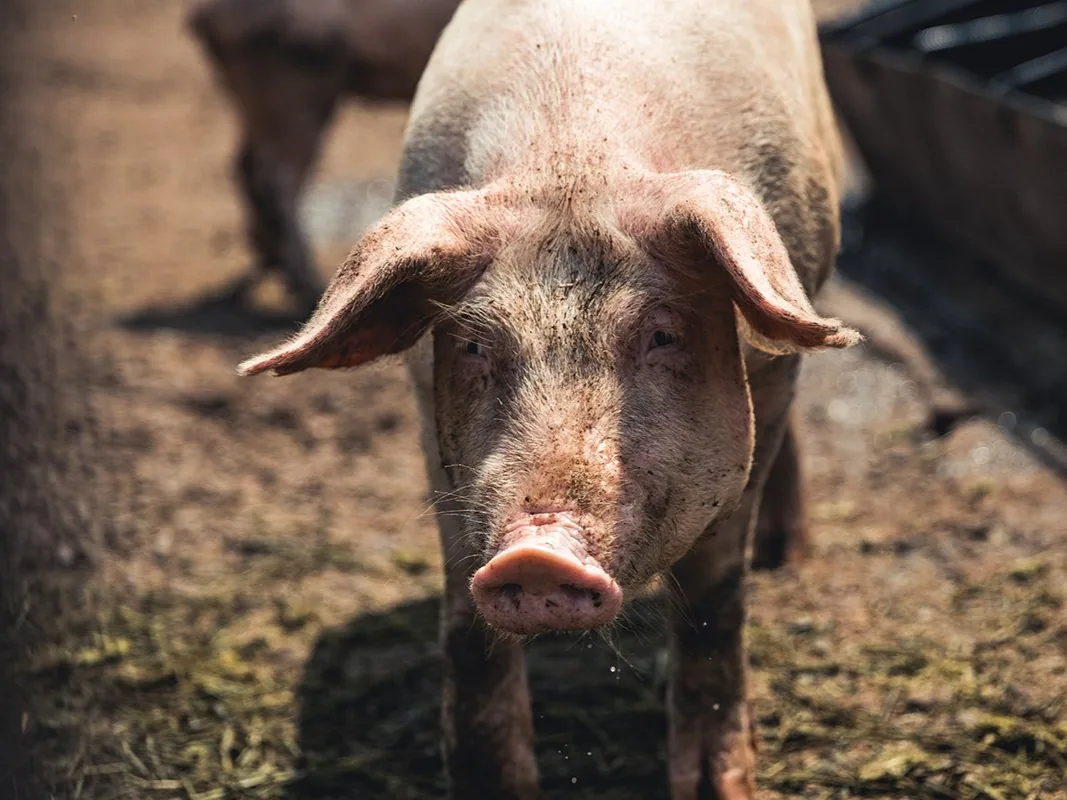
To this end, they use advanced computational techniques that allow for the creation of simplified and progressively detailed representations of the porcine circovirus B genome, an infectious agent characterized by high mortality in pigs.
Chilean and Uruguayan scientists—belonging to Centro Ciencia & Vida (FCV-USS) and the Institut Pasteur de Montevideo—are working on a joint study that seeks to explore the biotechnological potential of viruses, particularly porcine circovirus 2B, a pathogen that seriously affects the food industry due to its high mortality.
The process focuses on understanding how DNA packaging within the vector structure influences its stability, a line of research that aims to establish the knowledge base for designing new therapeutic mechanisms, both in addressing diseases and in using viruses as genetic information vehicles for treatments.
The study is based on the ability of these infectious agents to function as genetic transfer capsules, which would have implications for the development of therapies, vaccines, and DNA transport technologies—a strategy widely used today. An example of this was the use of modified adenoviruses as vectors in vaccines during the COVID-19 pandemic (AstraZeneca and Johnson&Johnson), in which the virus acts as a vehicle to introduce genetic instructions into human cells.
Understanding how the genome is organized within a virus is a “considerable technical challenge,” noted biophysicist Simón Poblete, a researcher at Centro Ciencia & Vida and one of the leaders of the collaboration. In this design, its stability plays a critical role because it determines whether the modified virus (vector) can fulfill its function without degrading prematurely. In many developments undergoing validation, such as cancer vaccines, it is a critical point and marks the difference between an effective therapy and one that fails before reaching its target.
A virus is a microscopic infectious agent that is not alive in the traditional sense, as it cannot reproduce on its own and needs to invade a host cell to multiply. It is composed, in its simplest form, of two main elements: genetic material (DNA or RNA) containing instructions for replication, and a protein capsid that envelops and protects that genetic material.
"If we do not understand the structure of the virus, we cannot design effective therapies. Studying genome packaging allows us to evaluate its impact on viral stability. If this internal order proves key, then we could think of ways to disrupt it to make the vector more unstable, which opens therapeutic possibilities. Although this is basic research, its application could extend to other agents, something we are working on with other models. It is a line with broad projection in health and biotechnology," commented Dr. Poblete.
Packaging rules
Can the way DNA is organized within a virus determine its resistance? That is the question driving the collaboration between Centro Ciencia & Vida, part of the ANID center network, and the Institut Pasteur of Uruguay. The vector used for this purpose is porcine circovirus type 2B (PCV2b), a small DNA virus that affects pigs and is associated with diseases such as post-weaning multisystemic wasting syndrome (causing immune system weakening and potentially leading to secondary infections and mortality).
Its high contagion rate and impact on livestock health make it a relevant concern for the food industry, especially in countries with intensive pig production. "Porcine circovirus is a small virus, but with high sanitary and economic impact," warned Dr. Poblete, who emphasized that it can cause respiratory diseases in livestock with a mortality rate close to 50% in the most severe cases.
The external structure of numerous viruses has been determined experimentally. However, little or nothing is known about the internal arrangement of the genetic material and how it influences the overall robustness of the virus. In this sense, the team seeks to understand the biological mechanism and also evaluate how this knowledge could be applied to new therapeutic strategies or genetic transfer tools.
The type of computational simulation on which the work is based is not only more economical than laboratory experiments but also allows for the exploration of scenarios at a scale that would be practically inaccessible with traditional methods. His counterpart in Uruguay is Dr. Sergio Pantano, a researcher at the Institut Pasteur de Montevideo, with whom he has developed a joint line of work that intersects physics, computational biology, and molecular structure simulation.
Although the results are still preliminary, the South American academics have already observed signs suggesting that the internal order of DNA can make the virus more or less stable in conditions such as increased temperature. The work began in his laboratory, studying virions—the complete and infectious form of a virus outside a cell—without genetic content inside, or with small fragments. Today, the aim is to study the complete virus through multiscale methods.
"The idea is to see if certain packaging rules confer greater stability to the viral capsid. If that is confirmed, we could think of ways to intervene in that order or even use the capsid as a structure to transport other types of genetic information," said Poblete, who has developed algorithms that generate multiple possible trajectories for DNA within the virus, evaluating which of these routes favor a more resistant structure.
From sketch to atom
Understanding how DNA fits inside a virus represents a complex scientific challenge. This is because, unlike the capsid, whose external shape can be visualized with relative precision using electron microscopy, the viral genome remains a flexible, dynamic structure that is difficult to capture experimentally. To address this gap, the team led by Dr. Simón Poblete resorts to a powerful strategy: multiscale computational modeling, a technique that allows representing the same system at different levels of detail, from a simplified scheme to a near-atomic reconstruction.
A process that the researcher himself defines as “initially simple, increasing in complexity rapidly,” adding that “first we generate a sketch: a three-dimensional grid, like a soccer ball, on which we simulate a moving chain representing the DNA.” From this simplified model, the team proposes different possible paths that the genome could follow within the virus.
These trajectories are progressively transformed into realistic molecular structures, using rules of physics and chemistry to define how DNA segments should connect, bend, and be distributed. Thus, models are built ready to simulate their dynamic behavior under different conditions, allowing observation, for example, of how the capsid reacts when the internal organization of the genome is modified.
Dr. Poblete quickly generates dozens of configurations—some more local, others more disordered—and delivers them to the Uruguayan team, which subjects them to computational tests with water, temperature, and envelope proteins. In this way, they can evaluate which packaging forms grant greater stability to the virus without the need for hundreds of laboratory experiments. Its advantages are methodological, scalable, and replicable.
“In systems as complex as a virus, one cannot simulate everything in great detail,” explained the biophysicist from the Centro Basal Ciencia & Vida. Therefore, the multiscale approach allows for smarter work: reserving computational resources to simulate only the most promising scenarios, discarding the unfeasible ones, and advancing with greater speed. This logic has been successfully applied in the study of proteins, drugs, and lately, viral RNA.
Now, the challenge is to use it to understand—and perhaps intervene in—the internal structure of viruses for therapeutic or biotechnological purposes. “Simulating is not just reproducing reality: it is a way of thinking about complex problems with precise tools. Instead of waiting for a perfect image, one generates scenarios, compares them, adjusts them, and learns. That is the strength of simulation: it allows us to see the invisible, but with rigor,” reflects the USS scientist.
Collaboration from the Global South
In addition to the technical aspects of the study, the project highlights regional scientific collaboration and the need to train human capital in disciplines such as biophysics and computational biology. Likewise, it demonstrates that doing relevant science with global projection from Latin America is possible.
“Computational modeling of biomolecules needs physicists, biologists, chemists, and computer engineers to address these problems from different perspectives. There is much to be done, and we need more people to join this effort,” concludes Poblete, who has also previously participated in research on other viruses and RNA structure in international therapeutic contexts.
The Chilean scientist explains that, in our country, multiscale modeling is still incipient, so these types of associations not only allow for knowledge sharing but also enhance scientific capabilities in countries facing similar structural challenges. “It is beautiful because it is not a distant collaboration; it is local, and that gives it a lot of value,” emphasizes the USS physicist.
According to him, these studies not only open new routes in biotechnology but are also key to training advanced human capital in Chile and the region. The combination of physics, molecular biology, and computational simulation requires interdisciplinary teams capable of addressing complex problems from different perspectives. “We need more people working at these frontiers of knowledge,” he stated.
From his laboratory at the Centro Ciencia & Vida (FCV-USS), he is already training doctoral students in projects that cross basic science and biomedical applications. His vision is committed to building local capabilities with global impact.
By: Luis Francisco Sandoval. Agencia Sandoval & Meirovich Comunicaciones.