

Predicting how this molecule folds would make it possible to design compounds able to recognise cancer cells, neutralise substances or act on different diseases. The challenge is to close a technology gap estimated at 20 years compared with proteins.
Knowing the sequence of a protein is not enough to know how it works. These molecules are made of chains of amino acids that, as they interact with each other and with water, fold into a three-dimensional structure. That shape determines their properties and allows them to act as enzymes, transport substances and perform many vital functions. It also makes it possible to study the effect of a mutation or to identify the site where a drug could act.
“If you want to know what a protein does, you have to see its shape. Sometimes they have two sections and a hinge; others look like a kind of clam or have helices. That structure is essential, for example, if you want to design a drug that acts on it,” explains Simón Poblete, researcher at Centro Ciencia & Vida (FCV-USS) and academic at the Faculty of Engineering of Universidad San Sebastián.
Obtaining these structures through crystallisation and X-ray diffraction, nuclear magnetic resonance or cryo-electron microscopy requires specialised equipment and can take years of work. For decades, different groups have sought a faster route through computational models.
The goal is to enter the sequence of a molecule into a program and obtain the structure it will most likely adopt. Getting there requires representing many physical and chemical interactions and then checking the prediction against a structure determined in the laboratory.
Since 1994, progress in this field has been tested every two years at CASP, the Critical Assessment of Techniques for Structure Prediction. Teams from around the world receive sequences of structures that have not yet been released and have a limited time to submit their models. Independent assessors then compare the predictions with the experimental results.
“The groups receive the sequence and have a few weeks to upload the structure they predict. Then the experimental structure is revealed and we see which method came closest. It is a blind assessment, and that is why CASP has been a critical forum for measuring how far these tools really advance,” says Poblete.
In this competition, AlphaFold, the system developed by Google DeepMind, showed the leap that artificial intelligence methods could make.
At CASP14, held in 2020, it achieved accuracy comparable to experimental methods for many individual proteins. Several problems remained, however. The models still struggle with complexes formed by several proteins, membrane proteins and proteins for which there is little evolutionary information. With RNA the gap is wider.
For a long time, RNA was thought to act mainly as an intermediary: it copied the information stored in DNA and carried it to the ribosomes, where proteins are made. Today we know that many RNAs do not follow that path. They also fold, adopt their own structures and take part directly in various cellular processes.
Proteins are built from 20 types of amino acids, while RNA combines four basic units. But this apparent simplicity does not make it easier to study. It is a more flexible molecule, it is hard to observe experimentally and far fewer known structures exist to train the models.
“RNA is about 20 years behind proteins in terms of technology and structural knowledge. It is as if we were in 2006. There are many things we still do not understand and, because few structures have been determined experimentally, artificial intelligence models also lack enough information to learn from,” Poblete says.
Part of the interest lies in aptamers, small fragments of RNA that take on a specific structure and can bind selectively to other molecules. This property allows them to be used to recognise tumour cells, neutralise substances or act on different diseases.
Poblete mentions work aimed at detecting breast and prostate cancer, neutralising the venom of the Chilean recluse spider and treating macular degeneration, a disease that affects vision. “There are few therapies of this kind, but it is a field with great potential,” he says.
To develop these applications, we first need to know more precisely how RNA folds and how it interacts with its environment. That is why CASP added the prediction of its structures and of its interactions with other molecules.
A group of his own
In its sixteenth edition the competition added a challenge: predicting how water and ions are distributed around an RNA molecule observed by cryo-electron microscopy.
Poblete took part together with the Italian researcher Dr. Fabrizio Pucci. Their simulations were among the best rated. The result allowed him to present the method at the CASP16 closing conference and to be a co-author of the publication that gathered and analysed the submitted work.
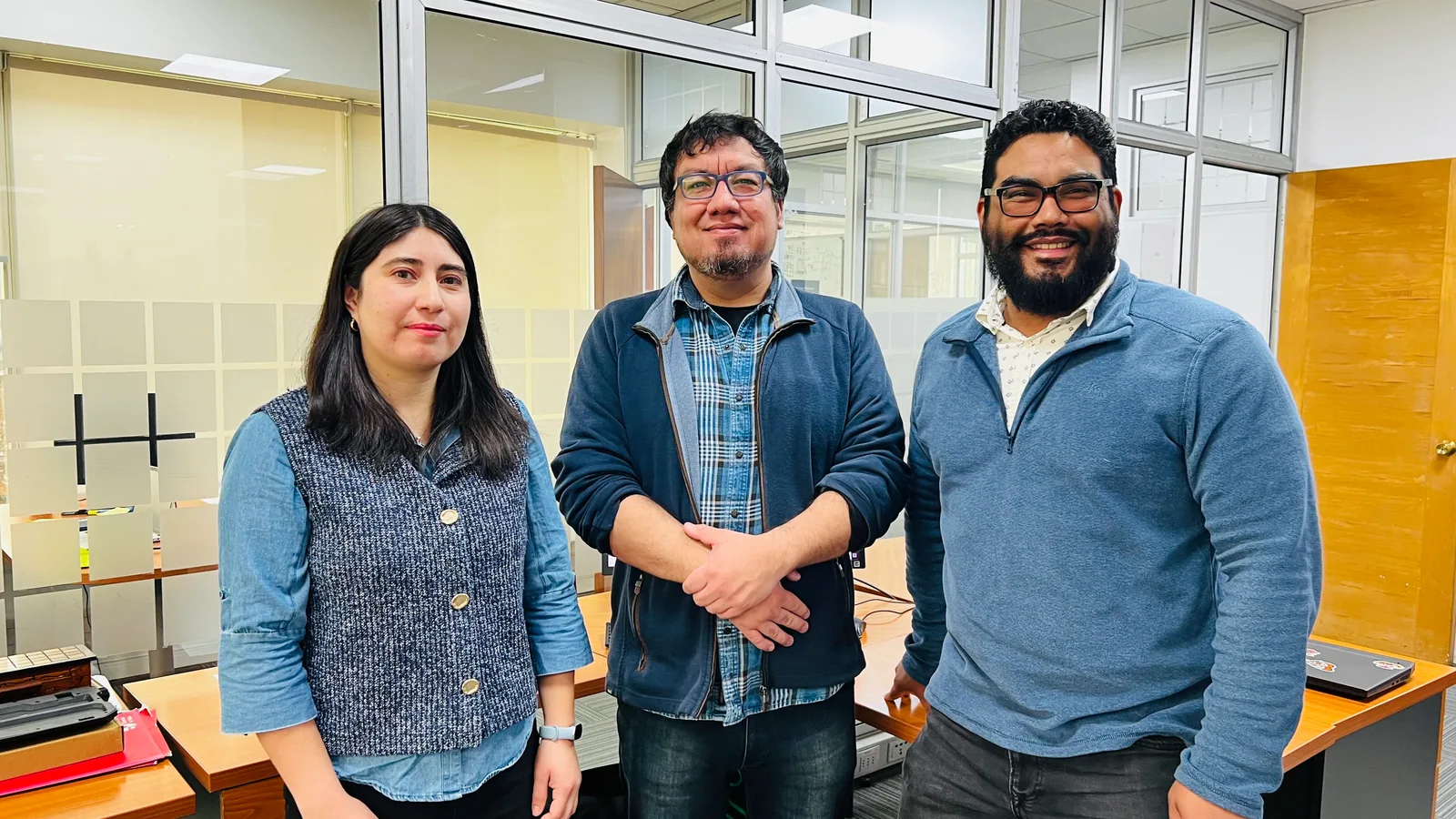
In CASP17, Poblete competes for the first time with his own group. He works with Dr. Alberto Martín, principal investigator at Centro Ciencia & Vida and director of the PhD in Computational Biology at USS, and Dr. José Gárate, academic at the university’s Faculty of Engineering, while the modelling work has been carried out mainly by PhD student Rossmarie Pincheira and postdoctoral researcher Estanislao Márquez.
“As a first-year student in the PhD in Computational Biology at Universidad San Sebastián, taking part in CASP17 has strengthened my training as I start out in RNA simulation and molecular dynamics. It has allowed me to bring together biology, physics and chemistry in a real structure-prediction challenge,” says Pincheira.
The team again took on the challenge of predicting the organisation of water and ions around RNA. To do so it uses computer simulations that simplify the representation of the molecules while keeping the essential physical and chemical interactions. This reduces the computing demands and makes it possible to tackle problems that, reproduced in atomic detail, would require far greater computing capacity.
For Márquez, the experience has also meant approaching biological systems from another perspective. “Simón gave me an extraordinary welcome when I joined his research group and involved me in the prestigious CASP competition. Taking part in this competition and in our projects has helped me shape a physical view of biological systems, especially RNA dynamics, complementing my training in chemistry and biology,” he says.
Poblete’s goal is to develop software that other researchers can use to enter a sequence, obtain a prediction of its structure or improve a preliminary model. He also collaborates with Polish groups working on the refinement and prediction of RNA structures.
Another line of his research studies how RNA is organised and packaged inside viruses such as HIV and others that affect pigs, salmon and birds. Understanding this process would make it possible to detect weak points during the formation of new viral particles.
“Conventional vaccines help antibodies attack the virus from outside. Here the idea is different: to understand what happens after it enters the cell and find a way to interfere when it starts to assemble,” he explains.
This knowledge would also help design systems able to encapsulate RNA for therapeutic purposes and deliver it to specific cells. For that, we still need to better understand its structure, its interactions with proteins and the role of water and ions in its stability.
Poblete sees this gap as an opportunity for researchers from different fields. “There is work here for computer scientists, biologists, chemists, physicists and mathematicians. There are many things we do not understand and an enormous number of problems to solve.”
Text by Richard García, Sandoval & Meirovich Comunicaciones.