
The doctoral project seeks to understand how the cells of a diseased liver interact before a tumor arises, in order to design treatments that prevent the disease rather than treating it once established. This is one of the most relevant programs in the world.
The doctoral project seeks to understand how cells in a diseased liver interact before a tumor arises, in order to design treatments that prevent the disease rather than treating it once established. It is one of the most prominent programs in the world.
The work will use spatial transcriptomics in a four-year Clinical Medicine PhD, funded through a research project supported by the British-Spanish CRIS Cancer Foundation, which is dedicated to promoting anti-cancer research.
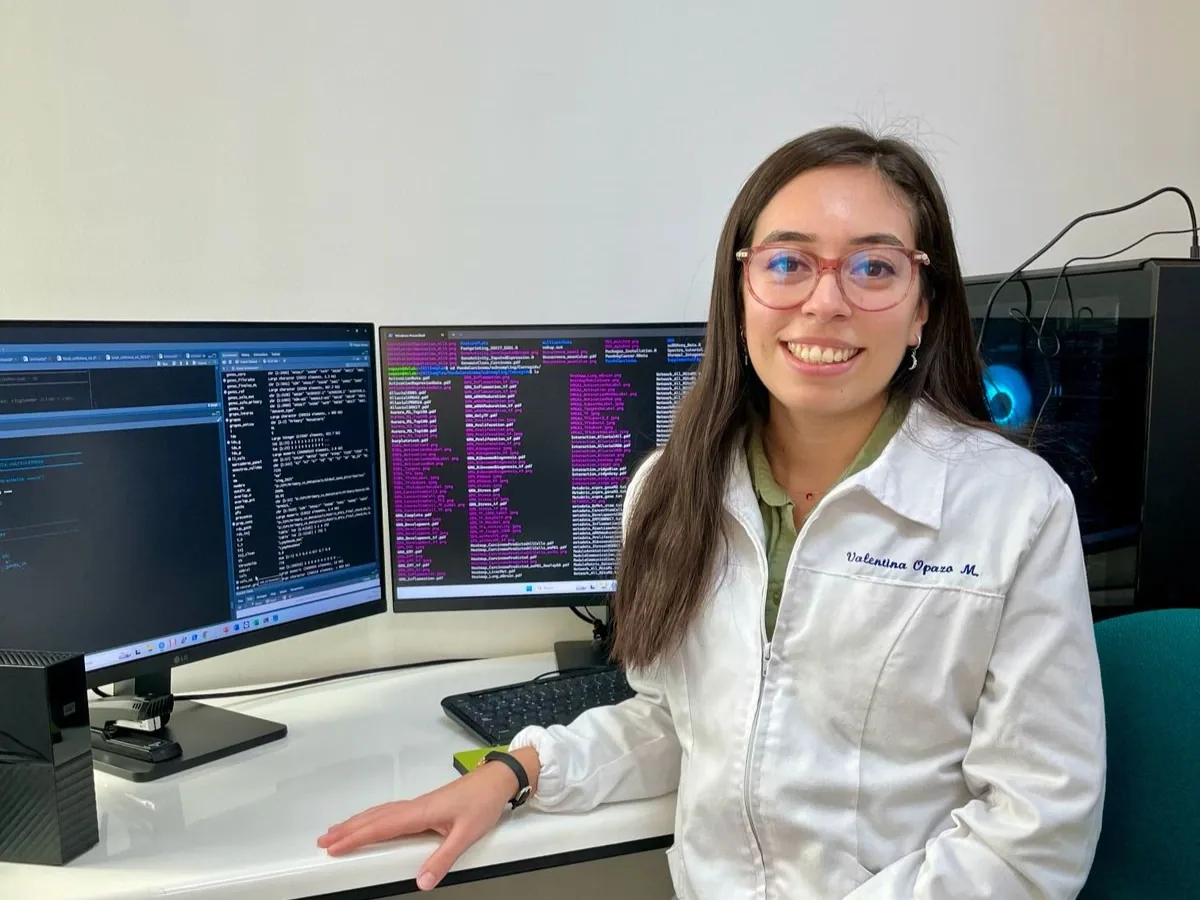
Valentina Opazo-Mellado, research assistant at Centro Ciencia & Vida (FCV-USS), will join the laboratory of Chilean scientist Felipe Gálvez-Cancino—trained at the same institution—to pursue her PhD in Clinical Medicine.
Valentina Opazo-Mellado, bioengineer and data analyst at Centro Basal Ciencia & Vida, has been admitted to the Clinical Medicine PhD program at the University of Oxford, England, the top-ranked institution in the world according to Times Higher Education for the tenth consecutive year. There, she will study how liver cells with cirrhosis interact before a tumor appears. The objective is to design new treatments focused on preventing the development of liver cancer rather than treating it once established.
Opazo-Mellado is a research assistant in the Tumor Microenvironment and Metastasis Laboratory led by Dr. Hugo González at Centro Ciencia & Vida, of Fundación Ciencia & Vida and Universidad San Sebastián (FCV-USS). She is a bioengineer with a master's degree in Biochemistry and Bioinformatics from Universidad de Concepción and will carry out her studies in the United Kingdom for four years.
The scholarship comes from funds that Dr. Felipe Gálvez-Cancino, principal investigator of the immune regulation laboratory at the Oxford Centre for Immuno-Oncology, University of Oxford, obtained from the British-Spanish entity CRIS Cancer Foundation. With these resources, he is funding Opazo-Mellado's studies; she will join his team and participate in a collaborative network with other research groups in the United Kingdom and Spain.
"It is one of the best universities to do science. Getting here also makes me think of all the work behind this opportunity and how my trajectory at Centro Ciencia & Vida was fundamental to being able to be here today. That gives me great motivation to keep growing and developing in this career," says the bioengineer, who was trained at Universidad de Concepción and Centro Ciencia & Vida.
One of the most competitive programs in the world
Dr. Hugo González, director of the laboratory where Opazo-Mellado was trained, states that the University of Oxford's Clinical Medicine PhD is one of the most competitive in the world: every year it receives applications from researchers across all five continents and offers only a handful of spots, forcing competition with profiles from the planet's most prestigious institutions. In addition, Oxford has headed the Times Higher Education world rankings in medicine for over a decade.
The fact that a researcher trained in Chile secured one of these spots demonstrates, in his view, that local capabilities exist and confirms Centro Ciencia & Vida as a reference hub for high-level scientific training with global connections.
"Oxford does not admit promises, it admits trajectories. Valentina arrives with concrete experience: she analyzed data from hundreds of patients, published in high-impact journals, and collaborated with teams from the United States, all from our laboratory. Her admission shows that globally competitive biomedical science is being done from Chile, and that centers like Ciencia & Vida can be the place where young talent in the region prepares to make that leap," Dr. González noted.
A window prior to the tumor
In most cancers, there is no prior disease indicating which patients have a high probability of developing a tumor, which arises without warning. Liver cancer is different. Hepatic cirrhosis predisposes individuals to this tumor, opening a window of time to study what happens in the tissue before the disease is established and to direct treatments at that stage.
To observe this stage, the project will use spatial transcriptomics. Each cell in an organism contains the same genes but activates only some depending on its function and environment, and measuring which ones are turned on reveals what it is doing. Other approaches analyze cells isolated from their tissue, something similar to surveying the inhabitants of a city without recording which neighborhood each one lives in. Spatial transcriptomics preserves this location and shows which cells coexist and how they communicate.
In a liver with cirrhosis, this information makes it possible to identify the cellular interactions that precede the appearance of cancer, the point where the project seeks to intervene. Opazo-Mellado's experience with this technique and in bioinformatic analysis was what caught Gálvez-Cancino's attention when evaluating her profile. "These are state-of-the-art techniques and, due to their level of specialization, it is much more difficult to access and develop them in Chile. For me, as a researcher, it is a great opportunity to be able to train in these technologies abroad and complement the experience I already have in bioinformatic analysis," she explains.
The choice of the liver also responds to a practical criterion. Having clinical samples is one of the most important conditions for this type of research, and patients with cirrhosis allow for obtaining premalignant tissue from individuals who do not yet have cancer. With this material, a temporal study is possible, following these changes in the stages prior to the disease.
Until now, Opazo-Mellado's work in Chile focused on the computational analysis of samples generated by other teams. In Oxford, she will add the experimental phase—from sample acquisition to processing—within Gálvez-Cancino's team, whose main research focus is defining fundamental mechanisms controlling antitumor immune responses. "It is a university where people from different parts of the world arrive, with very diverse experiences and areas of specialization. I believe being in such an environment will allow me to learn from other perspectives and continue growing academically," the scientist shares.
A network built from Chile
Dr. Gálvez-Cancino earned his PhD at Fundación Ciencia & Vida, and the two met during activities at that institution. Opazo-Mellado first heard him speak at a seminar and encountered him again at a congress of the Chilean Society for Cell Biology in Puerto Varas. She later coincided with him at the Advanced Course on Tissue Immunity, organized by Centro Ciencia & Vida (FCV-USS) alongside Institut Curie in January of this year. The full-day, week-long course brought together researchers from Institut Curie in France and the Karolinska Institute in Sweden, among other centers and universities.
Interacting during those days allowed the Oxford researcher to learn about the Chilean bioengineer's work. "It was an instance that allowed me to get to know and converse much more directly with researchers working in the field. Being able to share with them, learn about their research lines, and also show them my work was, altogether, key," Opazo-Mellado recounts.
In Dr. González's laboratory at Centro Basal Ciencia & Vida, Opazo-Mellado collaborated with teams from the United States and published in high-impact journals. She was in charge of the bioinformatic analysis of data from nearly 700 patients in a breast cancer study led by the University of California, San Francisco (UCSF) and published in Cancer Cell. The work developed through these collaborations allowed her to build links with international researchers who subsequently endorsed her application to Oxford.
The Clinical Medicine program begins in the coming weeks, and the doctoral candidate will settle in the United Kingdom. "It is a big challenge, but it is a challenge I chose and want to take on. Doing a PhD at a university like this is a goal I had since I was very young and built step by step," Opazo-Mellado states.
Text by Luis Francisco Sandoval, S&M Comunicaciones Agency.