

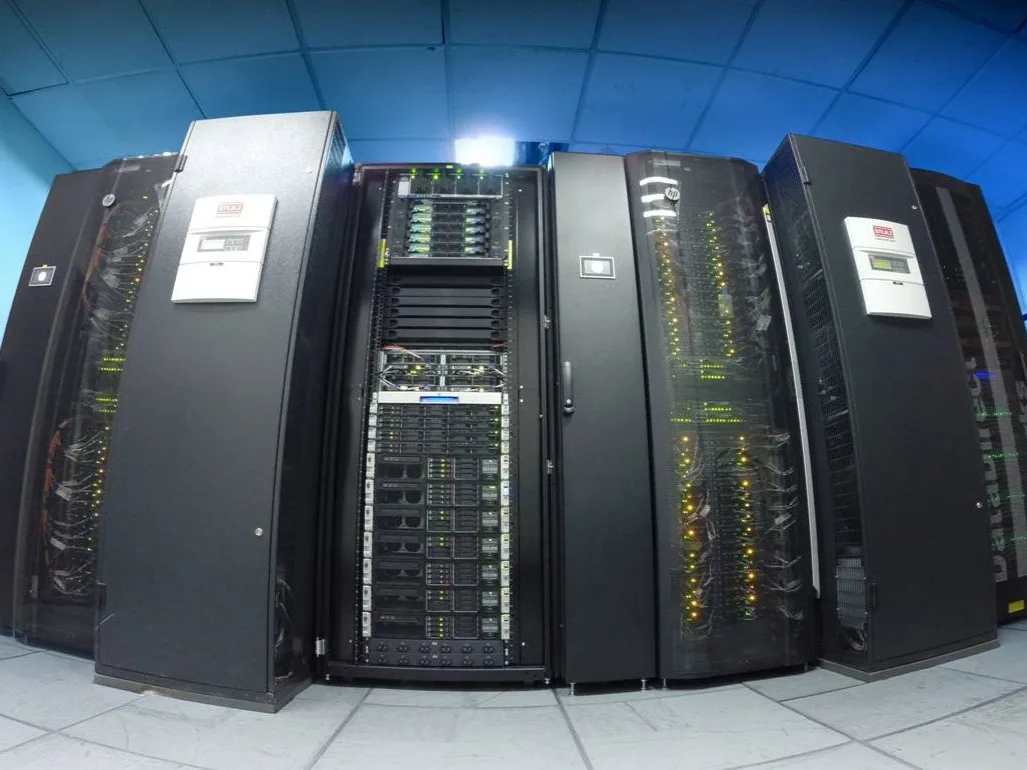
Fundación Ciencia & Vida and Universidad San Sebastián are part of the national SCAI‑Lab project, a new supercomputing infrastructure that seeks to drive scientific research and technological development in artificial intelligence.
Associate researcher at Centro Ciencia & Vida and USS academic, Dr. Alberto Martin, highlights that this initiative enables multiple opportunities for working with large volumes of data in areas such as artificial intelligence, computational biology, health, and energy.
Supercomputing, or the use of high-performance computers to process enormous volumes of data, is often associated with astronomical calculations or high-energy physics simulations. However, advanced computing power is also decisive for studying the behavior of millions of genes, proteins, or bacteria within the human body.
The research group led by Alberto Martin, acting director of the PhD in Computational Biology, academic at the Faculty of Engineering, and currently the representative of Universidad San Sebastián in the recently awarded national SCAI‑Lab project, operates at this intersection of biology and big data.
SCAI‑Lab (Supercomputing for Artificial Intelligence) is a collaborative project that seeks to implement an independent supercomputing infrastructure specialized in artificial intelligence, which will offer intensive computing capacity to research institutions, public agencies, and companies, thereby boosting strategic areas such as health, energy, the environment, manufacturing, and services. Awarded by CORFO with an initial investment of 7 million dollars, the project is led by the Universidad de Chile and brings together more than 60 public and private institutions, including USS.
In addition to installing state-of-the-art technical capabilities, the SCAI‑Lab project seeks to articulate a scientific and technological community capable of addressing complex challenges in knowledge, industry, and public services. For researchers like Alberto Martin, this effort connects with a previous track record: for over a decade, his team has worked with the national supercomputer operated by the National Laboratory for High Performance Computing (NLHPC), which has been key to the development of computational biology in Chile. "Almost all our publications acknowledge the support of the supercomputer. It is an essential resource for our experiments to be viable and comparable at an international level," he notes. In his view, the independent nature of SCAI‑Lab represents an advance in terms of equitable access: "It ensures that all participating institutions are on the same level to access these resources."
Biological networks and intensive computing
From his research group, Alberto Martin leads the development of algorithms to model complex biological phenomena from large data matrices. His specialty is building networks or mathematical structures that represent interactions between genes, proteins, or microorganisms, and applying machine learning techniques to identify patterns that cannot be seen with the naked eye. “A single matrix with 280,000 rows and 35,000 columns contains millions of elements. Searching for associations within that requires computational brute force,” he explains.
Some of his most recent work includes the detailed analysis of the genome of the parasite Leishmania -responsible for leishmaniasis- which allowed for the identification of new gene families relevant to the study of this disease. Another project focuses on the rational design of bacterial consortia capable of producing butyrate, a molecule with neuroprotective effects in diseases such as Parkinson's. Likewise, they explore the relationship between certain proteins and the prognosis in different types of cancer, combining clinical and molecular data in analyses that require tens of thousands of hours of computing.
“There are experiments that, if one wanted to do them with their own equipment, would not be viable due to cost or infrastructure. One of our recent analyses consumed 100,000 calculation hours in just over a week,” he comments. In this context, having shared platforms like SCAI‑Lab not only allows for more and better research but also reduces entry barriers for emerging groups and builds capacity from undergraduate to postdoctoral levels.
Dr. Martin proposes an integrative perspective, stating that at USS there are already various lines of work that require supercomputing, from molecular design and the simulation of biological systems to the analysis of satellite imagery or physical models. “Intensive computing is not a separate discipline, but a transversal resource. The interesting thing is that this type of infrastructure allows research that was previously unthinkable to find a place today.”
The awarding of SCAI‑Lab also opens a strategic opportunity: to bring these capabilities to new regions and universities, and to advance effective technological decentralization. USS's participation in this ecosystem strengthens its capabilities and joins a national effort to advance technological sovereignty and human capital formation.
For Fundación Ciencia & Vida, this alliance reinforces the convergence between genomic research and AI technologies. With SCAI-Lab underway, Chile takes a decisive step to compete in the global knowledge economy and lead the next technological revolution from Latin America.
The key objectives of the initiative are:
Distributed training of foundational AI models. Allow academics and companies to train large-scale neural networks by leveraging state-of-the-art GPU architectures.
Large-scale inference. Facilitate the deployment of AI solutions in critical sectors such as health, agriculture, mining, and disaster management, reducing response times and optimizing costs.
Advanced talent formation. Through training programs and workshops, it enables the enhancement of the preparation of data engineers, computer scientists, and biotechnology professionals.
Public-private linkage. SCAI-Lab will democratize access to high-performance resources, driving innovation in startups and the development of products with social value.
Original text: USS Vice-Rectorate for Research and Doctoral Studies .