

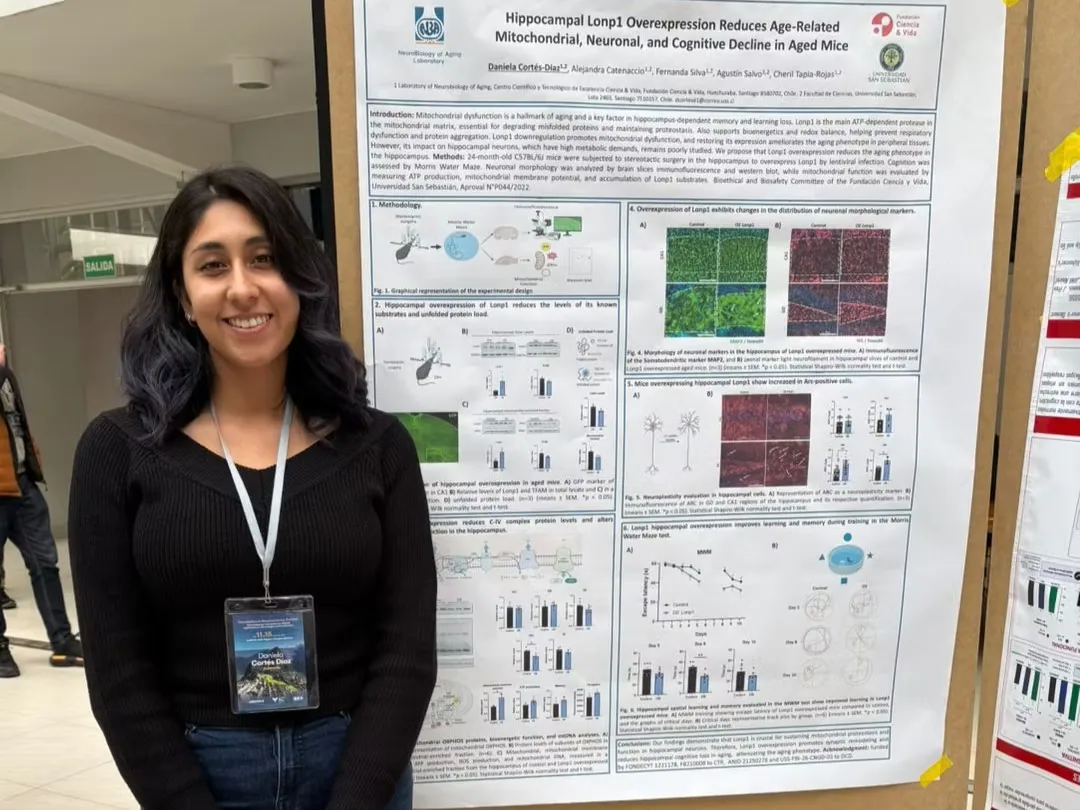
The article led by Daniela Cortés shows that the deterioration of a cleaning mechanism within mitochondria is sufficient to produce typical signs of aging in young brains.
The article led by Daniela Cortés shows that the deterioration of a cleaning mechanism within mitochondria is enough to produce typical signs of aging in young brains.
Daniela Cortés Díaz, a student in the PhD in Biotechnology and Bioentrepreneurship at Universidad San Sebastián, is the lead author of an article on brain aging recently published in the journal Free Radical Biology and Medicine.
The study was conducted at the Laboratory of Neurobiology of Aging, directed by Dr. Cheril Tapia , an academic at the Faculty of Science at USS and a researcher at the Centro Basal Ciencia & Vida . The research provides the first evidence in a living organism that Lonp1, a protein whose function is to eliminate other damaged proteins within mitochondria, is essential for the normal functioning of the hippocampus, the region of the brain associated with spatial learning and memory.
The team administered an inhibitor to young adult mice for six weeks, thereby partially reducing Lonp1 activity. That change was enough to cause a drop in cellular energy production, an increase in oxidative stress, the selective loss of small structures in neurons associated with plasticity, and difficulties in learning spatial tasks. Already consolidated memory remained intact. Thus, the findings identify Lonp1 as a causal factor in brain aging and open a possible therapeutic pathway to preserve cognitive function in old age.
"The main question was whether we could identify Lonp1 as relevant in the aging process," explains Daniela. "Although aging is a natural process and not a disease as such, it constitutes the main risk factor for the development of neurodegenerative pathologies. That is why it is important to identify key proteins that improve the quality of life of older people."
Researcher in training
Daniela also completed her undergraduate studies in Biochemistry at USS , and joined the laboratory in 2021 during her Research Unit. Since then, she has developed her work there: first as an undergraduate thesis student, then as a research assistant, and currently as a PhD student. "Daniela stands out for her commitment, experimental rigor, growing independence, and great capacity for learning, and today she also participates in the training of new undergraduate students as a co-tutor in different laboratory projects," notes Dr. Cheril Tapia.
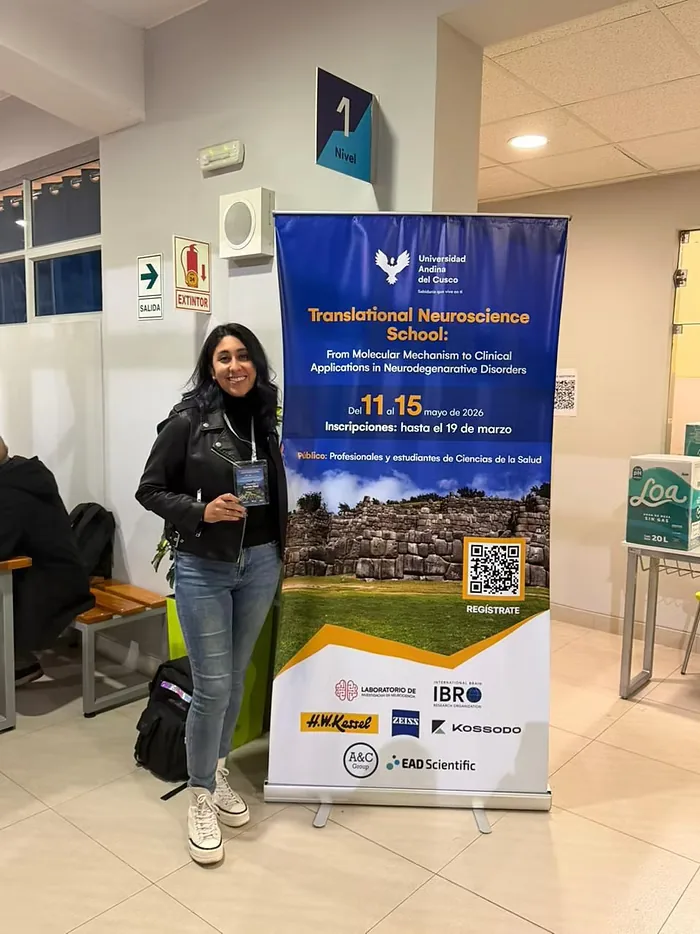
Likewise, she also comments on what it meant to lead the entire process of a scientific publication. "Having been the lead author allowed me to recognize all the effort behind each publication: organizing the data, writing the article from beginning to end, and defending it against the reviewers' comments."
In addition to this publication, Daniela participated in the IBRO Translational Neuroscience School 2026, held from May 11 to 15 at the Universidad Andina del Cusco, Peru. The school, organized by the International Brain Research Organization ( IBRO ), is aimed at early-career researchers, and its selection process considered academic trajectory, research experience, and professional projection.
"With this publication, the foundations are laid to evaluate the positive effects of Lonp1 on cellular functioning and its impact on memory. The next step would be to activate or increase Lonp1 levels in the hippocampus and observe if it can diminish the characteristics typical of the aged brain."
Text by: María José Marconi J., USS Vice-Rectorate of Research and PhD Programs .