

The study combines recordings of brain electrical activity and computational simulations to identify stimulation parameters that could improve working memory, and thus the ability to maintain and use information during a task.
The study combines brain electrical activity records and computer simulations to identify stimulation parameters that could improve working memory and, consequently, the ability to maintain and use information during a task.
Dr. Mónica Otero, an academic at Universidad San Sebastián and associate researcher at Centro Ciencia & Vida, leads this computational neuroscience project, which is conducted in collaboration with the Research Center in Cognition and Language at Universidad de Valparaíso.
Working memory temporarily retains and manipulates the information needed to complete a task, and its decline is characteristic of non-pathological aging.
A project developed in Chile uses computational models to identify how to stimulate the brain networks involved in working memory, with the aim of improving this capacity in adults over 65 years of age. The project is led by Dr. Mónica Otero, assistant professor at the Faculty of Engineering of Universidad San Sebastián and associate researcher at Centro Ciencia & Vida, Fundación Ciencia & Vida, and USS (FCV-USS).
Brain electrical activity records have already delineated the area where this neural network operates differently compared to that of adults aged 18 to 25.
Holding a PhD in Electronic Engineering from Universidad Técnica Federico Santa María, Otero was awarded a 2024 Fondecyt Initiation grant to fund this line of research in Computational Neurosciences, where she combines electroencephalographic signal processing with computational modeling and the study of brain network dynamics.
The research is being conducted in conjunction with the Research Center in Cognition and Language at Universidad de Valparaíso, within the university's Faculty of Medicine. Researchers María Francisca Alonso and Begoña Góngora coordinate the recruitment of participants.
The decline of working memory during non-pathological aging is well-documented by science. The network supporting this function encompasses a broad set of brain regions, where neurostimulation protocols allow for multiple parameter combinations. Thus, the work began by narrowing down which area responds to the task being tested.
“Saying that working memory is one of the first things affected in old age is a fact, and not part of a discovery we made in this work. However, the relevance of our study lies in using computational tools to predict how to stimulate the brain networks involved in working memory, with the aim of improving their functioning,” explains Dr. Otero.
How the brain coordinates to remember
Working memory temporarily retains and manipulates the information necessary to complete a task, explains the researcher, who was trained at the University of Havana, Cuba. It is the register that allows you to hold a grocery list in your mind for a few seconds, or recall the reason why you walked over to a coworker’s desk. Its decline can make certain daily living activities more difficult, without necessarily implying a disease.
The academic studies this function as the result of activity across a network of brain regions, rather than an isolated area. This approach makes it possible to measure how activity is coordinated among these regions during a task. “We have millions of neurons in the brain that synchronize their activity to perform various daily life tasks. Working memory depends on several brain regions working in a coordinated manner to maintain and use information,” she describes.
The initiative is limited to aging without associated pathology, meaning that dementias and other neurodegenerative conditions affecting similar functions are not addressed by its design.
The tool the team proposes to act upon this network is neurostimulation, a set of techniques that apply sensory or electrical stimuli to selectively activate specific brain areas. Each protocol relies on a combination of parameters, and it is this combination that the model attempts to anticipate before taking it to the laboratory.
“The project explores how, through computational models, we can predict certain parameters for neurostimulation protocols that can help reactivate these brain networks affected during non-pathological aging,” details Dr. Otero.
Two groups in front of the screen
The design compared two groups of different sizes. The control group gathered 25 adults aged 18 to 25. For adults over 65, meanwhile, the target was set at 45 participants. “Older adults show much greater variability in their responses. We do not all age in the same way, and that meant we needed a much larger sample size,” says Otero.
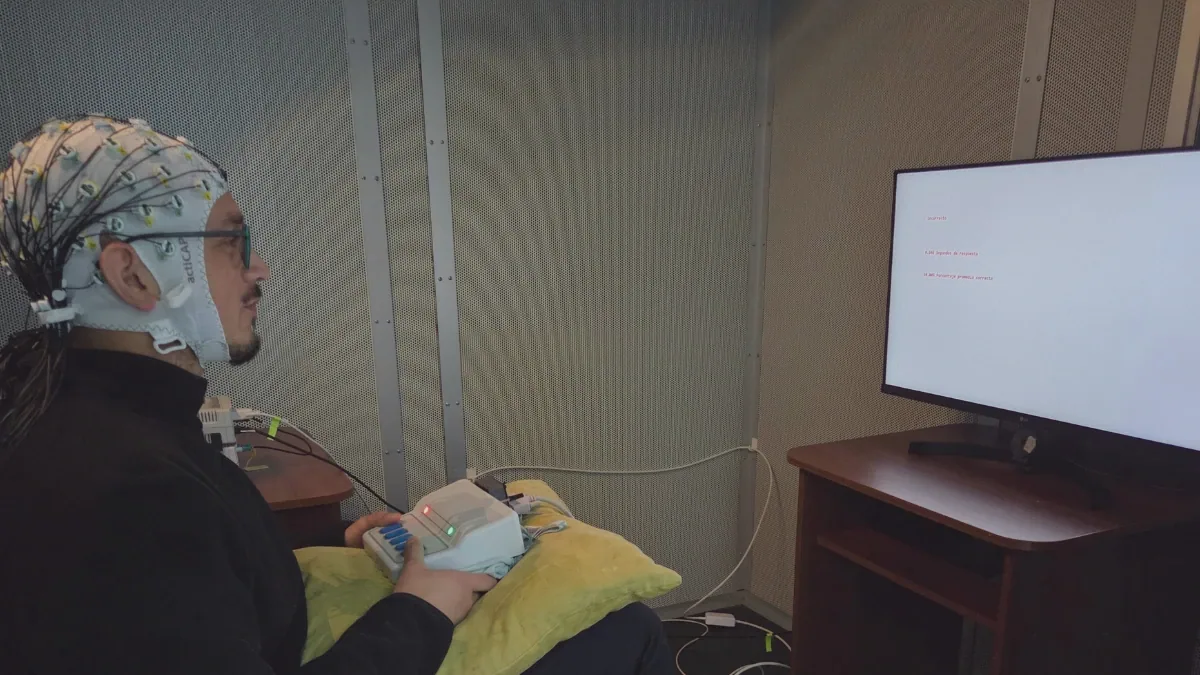
Recording is performed using electroencephalography, a non-invasive technique that uses electrodes placed on the scalp to record electrical signals produced by the joint activity of millions of neurons. Each session begins with five minutes without stimulation, inside a chamber isolated from acoustic noise and environmental electrical interference. This segment provides baseline activity—what the brain produces without external demand—and serves as a reference for everything that follows.
The task that follows tests working memory using two images separated by a short interval. The participant must respond whether the second figure is identical to the first or if it has been rotated, pressing a button to record the answer. The error rate makes it possible to establish whether they retained the initial figure and detected the change. “With this type of task, we can evaluate working memory performance and compare participants' responses, although on its own it does not allow us to diagnose a decline,” specifies the associate researcher at Centro Ciencia & Vida (FCV-USS).
Before starting the recording, the protocol verifies that the person sees the figures clearly, wearing glasses if they use them. The test includes a preliminary sample in which the task is explained and control images are presented. The objective is to rule out that a visual deficit is confused with a working memory failure.
The entire procedure went through an ethics committee. Each participant signs an informed consent form and can withdraw at any time. Data is disassociated from names starting from the moment of signing and is reduced to a code and age, the only personal background information the study retains, the research team points out.
The validation phase
With the differences between both groups already measured, a combination of stimulation parameters was estimated to modify the activity of the brain regions where the team observed these differences. This prediction is the core product of the concluding phase and will guide laboratory validation tests over the coming months.
Validation experiments begin next month and consist of applying stimulation with these parameters to older adults to assess whether it improves their task performance.
The results will allow the team to evaluate the model's predictions, make adjustments, and direct the next steps toward potential clinical application. Validation will make it possible to verify predictions and guide future clinical applications or other alternatives we need to test,” warns Dr. Otero.
The design also contemplates a scenario where the predicted parameters produce no effect. In that case, the question shifts toward the reasons for the discrepancy between the model and the recorded brain response—an outcome the team accepts as part of the work rather than the end of the project. The team has planned an activity in Reñaca during the first days of November with the older adults who participated in the recordings, to explain to them how the data they provided was used.
“In this way, we seek to foster exchange with society, especially with those who have participated in the research,” concludes the researcher.
Text by Luis Francisco Sandoval, Agencia S&M Comunicaciones.